
So, ARE you more than a lockbox key and a fill-in-the-blanks purchase agreement? It’s all about the value you bring to the transaction from a buyer’s perspective. I think your value is huge, but I’m curious to know what you think. Why should a buyer choose to work with you rather than anyone else? Or rather than go it alone?
Month: August 2010
More on Value
I am really old. I am so old, people in their 40s routinely call me ‘Sir.’ I’m so old, when I do crunches at the gym, I literally hear crunching. I’m so old, my dog, Homer, thinks he’s an assistance animal. I’m so old, young mothers burdened with babies and bags of groceries routinely hold the door open for me. I’m so old a punk on the sidewalk called me ‘Grandpa’ the other day.
Having now publicly wallowed in all that wrinkly tommy-rot, I must admit there are some benefits from being older than dirt. One such benefit is the fact that I actually know a couple of things.
We’ve been talking about the Buyer Inquiry and Buyer Data Sheet and, today, about Buyer Objections (which I prefer to call Buyer Questions and Concerns . . . it’s less adversarial). Often our conversation has gotten back to demonstrating your value to the consumer when he or she makes contact. That seems essential.
Here is a Great Truth: Nobody ever does anything they don’t want to do.
Let me repeat that: NOBODY EVER DOES ANYTHING THEY DON”T WANT TO DO. Even if they’re choosing the lesser of evils, they are making a choice.
So your task, when that potential Buyer makes contact, is to make them want to meet you.
As you probably already know, nobody who ever calls you for the first time wants to meet you. Meeting you is the last thing they want. They want to get the information you have as quickly as possible with a minimum of entanglement and to get off the phone. They will pause and absorb only when something extraordinary happens:
- Either the house they are calling about is absolutely perfect for them in every way OR
- You demonstrate the ability to bring so much value to the home search and purchase process that the caller can’t wait to get together.
There’s a word for getting people to want what you have. It’s called ‘Salesmanship.’ And when used properly, it is not dishonest, manipulative, opportunistic, harmful or fattening. Great salesmanship is knowing your business so well that you shine like a polished gem. Great salesmanship is being willing to educate the other person about a process in which you are expert. Great salesmanship is knowing, right down to your marrow, that nobody can do a better job for this caller than YOU. Believing so strongly in what you know and what you do, you reach out to consumers with near missionary zeal. Really, gaining the right to help people make good decisions becomes your mission. (In fact, I don’t think it would be a bad idea to slip that phrase into your cadre of dialogs: ‘My personal mission is to help people make good real estate decisions.’ )*
For years, when I worked for Brand X, I devoted lots of time to meeting with and interviewing our top producing salespeople. Because I was designing training, it was important that I knew what the top people were doing. These great salespeople had a few things in common: they all had a strong sense of mission about what they were doing. They knew their business so well that they were supremely confident they were the best person to help the consumer. And helping as many people as possible to make good decisions was the only goal that seemed to matter. Honestly, I rarely met a great salesperson who could tell you how many deals they’d done this year or what their gross commission total was. That wasn’t important to them. What was important was the customer whose transaction had snarled and whose living room furniture was now being stored in their garage. What was important was getting that family comfortably relocated before the start of school so the kids could go into the new situation on day one. What was important was finding that perfect house in that perfect neighborhood with the mother-in-law suite downstairs so the family could be together.
When you have the accent on that syllable and can back it up with solid knowledge of inventory, finance and the real estate process your value just oozes out. The potential Buyer recognizes it quickly and is anxious to meet you. Suddenly he or she wants what you have. I don’t guess I’ve ever heard anyone demonstrate the value he brings to a Buyer transaction any better than Jack Bailey. He did it again today in our National Sales Meeting when he volunteered to role play a Buyer Inquiry call. Luckily, we have tons of video of Jack doing this in the Download Library and you really ought to be taking a regular look at that wonderful material.
*For a real example of that sense of mission, I have a short video clip of a great salesperson. Cindy Coplin Mitchell works in Athens, Georgia and lives her business with passion every day. Here, she’s talking about working with FSBOs, but I think you’ll see what I’m talking about. I am sad to say, she does not work for us . . . but who knows? Enjoy!
New Website Features
We just got finished with another Tech Time Tuesday webinar with Robert Stevens. Robbie shared some new functionality on the Help-U-Sell Broker websites that I think we should highlight here. But first, some basics:
Your listings get on to your (new) Help-U-Sell office website in one of two ways. You either enter them manually via OMS or you input them into your MLS and it comes to your office site via the IDX feed you have set up. (Note: we are talking only about your new Help-U-Sell office site, the one that Help-U-Sell corporate hosts and maintains. We’re not talking about your New Home Page website or your Point2 website or any other you may have.)
Generally speaking, your Help-U-Sell office website offers more capacity for images and greater functionality than most MLS’s, so once the listing comes into your website via IDX, you may elect to edit it in OMS, add pictures, virtual tours, or tag it as Help-U-Sell Homebuyer Stimulus eligible. Here’s where the new functionality comes in.
In OMS, in the Listings area, when you access your listings, you’ll see a coded icon at the far left of the list of properties. A grey circle with an ‘A’ in it means ‘Automatic’. These are listings that have NOT had any changes made to them after they came over via IDX. Because there have been no changes made, a price change input into MLS will automatically be reflected on your Help-U-Sell office website. Note that in these cases, price will be the only change made in MLS that will update your Help-U-Sell office website. Changes to status or comments made in MLS will not be reflected — and you’ll need to enter them manually in OMS to change your listing on your office website.
If, however, you make any change to your listing after it comes over via IDX — change the price or status, add pictures, edit comments, correct an error — the icon code on the left side of your list of properties will change to a red circle with the letter ‘M’ inside, ‘M’ standing for Manual. From that point forward, a price change input into MLS will also need to be input manually in OMS for the change to reflect on your Help-U-Sell office website.
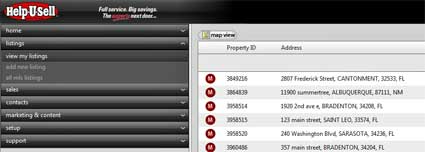
I know this is a little confusing but it all gets down to the system you orchestrate in your office for listings and listing maintenance. As a Broker, I would simply add a step to any change in a listing: after making the change in MLS, make it again in OMS. That way I will know that everything is up to date. If, the change you’re making is a price change, when you get into OMS and see that the listing in question has the grey circle ‘A’ next to it you may decide to wait a day for the IDX feed to make the change. (Me? I’m going to make the change in OMS right then and there so that I know it’s done and it reflects immediately.)
Generally speaking, IDX feeds come in once a day, often in the wee hours of the morning. So a price change made in MLS on Tuesday afternoon will likely come over until Wednesday morning (again, we’re assuming this is a listing tagged with the grey circle ‘A’, with no changes having been made in OMS.).
The other great bit of news on today’s call had to do with content creation and management on your office website. You’re now able to add new pages of content to your new Help-U-Sell office website by going into the content manager in OMS. This exciting development means you can go hyper-local with your office website, highlighting some of the nuances that affect your marketplace. Perhaps your State or Municipality has a special program to encourage home ownership; that might deserve its own page. Perhaps your office is participating in a big local charity event; that might be another page. Remember that every page of your website is indexed by the search engines so each page represents an opportunity to attract more visitors to your site and to generate more leads for your business.
The new Help-U-Sell office websites continue to grow and improve . . . it’s an exciting process. If you’re not tuning in to Tech Time Tuesday each week, you’re missing out on some great stuff. Thanks, Robbie and team! We appreciate the great work your doing for us.
What is Value?
I am a home buyer. I am looking for my dream home. My list of wants is large and a little vague. My list of needs is much smaller and well defined. My past experience with REALTORS hasn’t been bad . . . but I’ve never been through a transaction without gasping a little when I saw the commission expense on the HUD-1. I’ve been cruising the Internet looking at listings for a couple of months and have sent inquiries on a number of properties. I have been surprised at how often my inquiries have gone unanswered (!). I have yet to stumble across an agent who seemed to have much to offer in my home search process. I mean: everyone was nice, but I didn’t get the sense they brought much to the table . . . except maybe a lockbox key and a fill-in-the-blanks purchase agreement.
This buyer – or one very much like him – is probably going to contact you today. How will you secure a working relationship with him?
It’s pretty clear that if you ‘wing’ it, relying on your sparkling personality and natural gift of gab, you’re probably not going to get anywhere. You’re going to have to do something different than all of the other agents he’s already contacted. Here are some ideas:
- Use the Help-U-Sell Buyer Data Sheet. It is designed to help you lead a caller through discovery of the tremendous value you bring to the transaction.
- Practice, practice, practice . . . but do so before the phone rings. Don’t think you’ll polish up your phone skills when this buyer calls. They need to be polished before you even say ‘Hello.’
- Answer the caller’s questions, but never answer without immediately asking a follow-up question of your own. “That home has 3 bedrooms, how many were you looking for?’ ‘It is priced at $289,500, in what price range were you looking?’
- Your goal is to gather as much information as possible, demonstrate your value, and build rapport. Conversational open-ended questions will help you do that. Open-ended questions are ones that cannot be answered with ‘yes’ or ‘no’.
Look for opportunities to bring value to the process. Value is a perception. It’s something the caller either perceives or doesn’t perceive. It’s true that you can sometimes make the ordinary seem valuable by presenting it in a special way. For example, Al Savastano used to refer to his Conference Room as his ‘Media Room’ when asking prospective buyers to come into the office. ‘I’ll reserve our Media Room for you and we’ll go live on the MLS and search for properties.’ That sounds much more special than, ‘Let’s meet in the Conference Room and go through the MLS.’ Presenting things in the best possible light is fine. However, value is more than packaging and language. Value is real. It’s real stuff the potential buyer can use to make the search process easier or more enjoyable. Here are some examples:
- Your knowledge of inventory. If, after getting a clear picture of what the caller is looking for, you can rattle off 2 or 3 or 4 properties you’ve seen that match, the caller will see you as the area expert — someone who will bring great value to the home search process. I don’t believe you can ever be that quick or clear on the phone unless previewing inventory in your marketplace is part of your weekly routine. You have to physically go out and see the property.
- Your knowledge of finance. You don’t have to be a loan officer but you should know the basics of what it takes to qualify for a mortgage today, what typical downpayments are, how to calculate a payment on the fly and so on. Meet with your favorite lender and ask them for ‘rules-of-thumb’ you can use when talking with potential buyers. Things like, ‘If you have decent credit, most lenders will consider a mortgage that’s about 3 times your annual income.’ ‘At today’s rates, you’ll pay about $5.20 per $1,000 borrowed on a 30 year fixed rate mortgage, so if you borrow $200,000 your payment will be about $1,o40.’ NOTE: do not use the two examples I just tossed out. You need to talk to a local lending expert to get good factors for your own area.
- Your knowledge of special programs and incentives. Many States, Counties and Cities have special programs to encourage home ownership. They can include downpayment assistance, interest rate subsidies, even preferential pricing. You learn about them by digging: constantly ask your lenders if they know of any such programs in your area.
- A Buyer Consultation where you review the home search and purchase process, get an understanding of the buyer’s wants, needs and capabilities, and create a Real Estate Plan that clarifies what you’ll be trying to accomplish working together.
- Listingbook. If your MLS has it, I know of no better tool to give a potential buyer. Through you, they’ll get real time access to the MLS. You’ll be able to monitor what they’re looking at and you’ll also have the ability to communicate and share with them through the program. I’ve never met an agent who took the time to learn Listingbook that didn’t say it greatly improved their ability to convert buyers. It’s also very helpful on the listing side of the business.
- Sikku. Like Listingbook, Sikku provides a search platform for buyers based on the local MLS. In additional to a traditional website, however, Sikku allows them to get the information on their smart phones, so if they pass a home for sale and are curious, they can easily pull the information right there in the car.
- Free List. Whether it’s weekly, daily or at the moment, a list of properties for sale with addresses and prices can be very valuable, especially when some of the properties are not in MLS. There are many areas were a Free List of Foreclosed Properties is seen as valuable.
- A mortgage consultation where various loan products are explored and where a pre-qualification letter can be generated. You want your best lenders doing this for you BUT you want to be present, even if it’s happening over the phone. Remember: it’s about building YOUR value. The lender needs to be seen as an extension of your business, your service.
There are many other valuable services you can offer potential buyers — these are just some that are on the front of my mind. I’d love to hear what you’re offering buyers who call your office. Why not add a comment and tell me what you’re doing.
Mastering the Buyer Inquiry
Yesterday, on the regular Wednesday Help-U-Sell training webinar, we worked on the Buyer Inquiry. I think this is one of the more critical moments in the client life-cycle, if not the most critical. It’s the place were all of the power and energy of the marketing program falls right into the hands of the person answering the phone. This is the Arena for your real estate career, where it all happens. It’s the Moment of Truth you will either leave with the beginnings of a client relationship or leave with nothing. It is clearly where the rubber of all your preparation and hard work meets the road. I am absolutely convinced that this is the single most important skill to polish if you want to increase your production and your own bottom line . . . and I’m not kidding or puffing the goods.
Think about it: if 1 in 10 buyer inquiries make it to the closing table, how much better would your income be if 1 in 5 buyer inquiries made it to closing? Right: Twice as good. So, without even listing more or improving your closing ratios, you could double your income right now by mastering this little five to ten minute phone conversation!
You are in business to help people sell and purchase real estate. Your measure of success is closed transactions. You spend thousands of dollars each month to attract the buyers and sellers who will fuel that process. The Buyer Inquiry phone call is the bridge that connects all of your marketing dollars with the big payoff of a closing.
Think about your car for a moment. You have an engine under the hood. It’s powerful, but all by itself it’s not going to take you anywhere. To GO, you have to have something else: spinning wheels. Of course, without the engine, the wheels don’t spin and you still don’t go anywhere. In your car, there is a contraption that sits between the engine and the wheels that translates the power of the engine into the spinning of the wheels and it’s the Transmission.
In your office, Marketing is the engine. It powers everything. The end result, the spinning wheels, are closings – that’s what we want. But without a strong transmission – the well executed Buyer Inquiry call — we don’t go anywhere. Let’s put some numbers to that.
Let’s assume it costs $85 to make the phone ring one time in your office with a potential buyer on the line. Now, I didn’t just pluck that $85 from thin air. I’ve been working with brokers on operational issues like this for 30 years and I can tell you those who did the math were usually surprised to discover that every buyer inquiry cost between $80 and $100 dollars to generate. If you were to add up everything you spend to market your company and then divide that by the total number of buyer inquiries you receive over a period of time, you’d know your own cost . . .
So, everytime you pick up the phone and it’s a potential buyer on the other end, just picture that you’re holding about $85 in your hand. You can either toss it in the trash can . . . or you can INVEST it in your business by capturing that buyer lead. The payoff for capturing the lead can be very large: like about $6,000 – that’s what the average buyer side commission is in Help-U-Sell today.
Of course, you know and I know you’re not going to get every single buyer inquiry to the closing table. In fact, you probably won’t get most of them. But let’s just assume it takes 50 buyer inquiries to create one closing – then your cost to create the closing (not counting your time showing, negotiating and handling details) is $4,250 (50 inquiries X $85 per inquiry), and that leaves a pretty small return at the end of the day . . . one for which it’s probably not worth staying in business!
So, let’s see what happens when we start doing a better job on the phones. Let’s assume for every 10 buyer inquiries we receive, we are able to get one to closing. Then our investment (at $85 per inquiry) is $850 and that’s starting to look like a pretty good return: invest $850 to receive $6,000? Pretty good.
But, I think you can do better than that. I believe if you work on the Buyer Inquiry diligently and continuously, you can get that down to 1 in 5. And now your investment is $425 (5 x $85) and your $6,000 return is more than $10 for every $1 invested in marketing. Now that’s a business worth having.
At Help-U-Sell, we have a tool for capturing that buyer inquiry and turning it into a prospect. It’s the Buyer Data sheet and it is utterly simple and brilliant at the same time. You owe it to your income, your career, your office, your family . . . but mostly to yourself, to practice handling incoming calls every week (if not every day). If you are a broker/owner, make role play of the Buyer Inquiry part of your company culture. Do it every week, several times a week. Do it so often that the natural discomfort that comes from exposing your skill level before your peers goes away. Do it until it just becomes what you do in your company. If you are an agent, make a pact with a partner. Commit to regular focused practice on this one key skill. Role play, critique, try different scenarios. If you do, I promise: you’ll see a corresponding increase not only in your numbers of buyers, transactions and closings . . . but also in your income.