
How To Do It: Step 8 – The Easiest Company To Work With

(This is an elaboration of ‘How To Rule The (Real Estate) World in 10 Easy Steps”)

Truth:  If you do your job well, your competitors will dislike you . . . at least at first.  This is especially true at Help-U-Sell because we have a business model and consumer offering based on consumer savings.  Our mere existence represents a threat to the status quo, the old fashioned way of doing business, the one-size-fits-all percentage based commission way of  doing business.  Every listing you take, every sale  you make is one that your traditional counterparts won’t get.  Of course they’re going to dislike you!

In fact, I’ve said many times that if they don’t dislike you (at least a little), you’re probably not doing it right!

But, if the experience of our members over time is any indicator, you can be less feared, less despised and more respected if you work at being the easiest company in town to work with.  Here’s how to do that:

Don’t withdraw. Take the rotten tomatoes your competitors throw at you in stride.  It’s not personal.  They’re just responding out of fear and uncertainty.  Be sympathetic.  They’re just doing what people do when a game changer is inserted into their arena.  Most of us tend to retreat into our own little universe when faced with a bucket load of bad gossip about us.  Don’t do that.  Keep your head up, keep your smile in place, and keep interacting with your  fellow brokers.

Don’t go changin’ to try to please them (Billy Joel, sorta).  At the same time, stay true to what and who you are.  You are different.  You have a different business model and a different consumer offering.  The pressure to relax in key areas and to become more like everyone else will be strong, but you must resist!  Of all the magical powers you possess (you superhero, you), none is more powerful than the fact that you are different.  Embrace that difference.  Be true to it.  Vive La Différence!

Get active.  Don’t just join the board and the MLS:  attend the meetings, volunteer for committees, help make the local industry better for everyone.  In a word:  become a leader.

Know your stuff.  Study contracts and finance.  Know how to put together any kind of deal.  That co-op agent bringing you an offer probably doesn’t know nearly what you know.  If they leave the transaction having learned from you, a wary competitor will probably turn friendly.

Take over. We all have our roles in our transactions and the tendency is to get tunnel vision on our own duties, not to worry about what the other person is supposed to be doing.  Rather than becoming positive and helpful when the other side drops the ball, we’re supposed to become incensed and self-righteous.  It reminds me of a favorite photo I found some years ago:

Step 9!

That transaction is everyone’s job.  You should be willing to do whatever it takes to bring the sale to closing.  That means to do your job impeccably and to step in when anyone else’s job bogs down.  Instead of, ‘Why haven’t you done this and that?’  ask, ‘What can I do to move this forward?’  You know:  there’s never been a real estate transaction without a problem.  So many things can go wrong between contract and closing and the ball an be dropped in any number of players’ courts.  Be ready willing and cheerfully able to step in and solve the problem even if it’s in someone else’s lap.

Treat your competitors as if they were clients. Court them.  Nurture them.  Remember that anyone you share a transaction with may become a member of your team some day.  Do whatever you can to make their job easier and to demonstrate the power of your own program.

And . . . don’t take any @#$^.  I don’t really need to elaborate this one but if they cross the line, respond quickly, forcefully and professionally.

What happens when you become the easiest company in town to work with?  Traditional agents refer clients they can’t help to you.  Traditional agents sometimes even list their own property with you! (really:  I’ve seen it a number of times).  You get elected President of your Board.  You are awarded REALTOR of the year.  But best of all, you stay in control of your transactions, in control of your business and on top of the world.

And here is Step 9!
Negotiating Tips For Buyers and Sellers

Everybody wants a deal today.  Buyers, understanding that they hold the keys to the kingdom, want the best house at the lowest price and the most favorable terms.  Sellers, often facing some kind of loss (even if it’s just a loss in perceived value) want to cut a deal that will be least painful and put them in the best position moving forward.  One of the things they look to us for is help in negotiating.  We advise and then work to advance and protect their positions.

But your ability to negotiate effectively on behalf of a client is dependent on many things within the client’s control.  They have to be realistic and flexible.  They have to be very clear on what’s most important.  They have to be creative.

This morning’s Trulia newsletter has a nifty little piece presenting negotiating tips for buyers and sellers.  It’s a snappy summary of the attitudes and strategies your clients need to embrace to be most successful in a negotiating situation.  I think it would be a great item to reproduce and share with your clients at the beginning of the relationship so that when you get down to offer and acceptance they will understand their role a little better.

Here is a link to the full article.

Recruit! Recruit! Recruit! Red Flag

Here’s a direct quote from a franchise sales solicitation one of our brokers received:

“At Realty World, we understand that recruiting is your number one priority”

Funny.  I thought the number one priority of a real estate company was selling real estate.

I don’t mean to pick on Realty World.  If you ask any other national franchise what’s most important, they’ll tell you the same thing:  recruit, recruit, recruit.  It’s just that RW is the latest to solicit our members, a practice that could be considered tortious interference with a contractual relationship (regardless of the legal disclaimers at the bottom of their solicitations).  It’s kinda like one of your competitors going to a seller who has his or her property listed with you, telling them they should cancel and list with them.

I think if I were up against Realty World for a listing presentation, I’d share that little quote with my prospective seller.  Seems to me they need to know they’re not Realty World’s number one priority.

In fact, why not start collecting this stuff.  Really – if you read through the franchise sales solicitations of any of the national brands they’ll assert all kinds of stuff that leaves the consumer out in the cold.

Of course, if you are a broker stuck in the quicksand of the old agent-oriented model, recruiting must be your number one priority.  With average agent production hovering somewhere between 4 and 6 closed sides a year, you’re going to need a ton of agents to pay the electric bill!  Especially when your number one tool for recruiting them is an 80% commission split!

(Cut to a traditional franchised broker’s office somewhere in suburban America.  The broker is sitting behind his desk, his franchise representative sits across from him.)

Broker:  I’m working my #)$I% off and I’m absolutely goin’ broke here!

Rep:  Are you recruiting?

Broker: Sure I’m recruiting!  I recruit every day!

Rep:  How many new agents did you add last month?

Broker:  Two.  But I lost three!

Rep:  Oh . . .why did you lose them?

Broker:  This nutcase down the street is offering 90%.

Rep:  Did you offer to match it?

Broker:  Of course not!  Do you think I’m out of my mind?

Rep:  No.  But I know if you’re not making money it means you don’t have enough agents, and if you can’t get and keep agents it probably means your split is too low.

Broker:  Let me make sure I understand . . . Right now I have 30 agents and I’m paying an average of 75% and each of them is doing about half a closed side a month and I’m not making any money.  You’re telling me if I raise my split to 90% I’ll make money?  How can that be?

Rep:  It’s all about numbers.  You don’t have enough agents.  If you had enough you’d make money.  That’s the way other offices do it.  Recruit, recruit, recruit . . .

Broker:  But I thought I was in the real estate business!

(Fade to black . . . )

That’s so sad it’s hard to chuckle.  But it’s a conversation that’s repeated daily in the traditional real estate world.  Rarely does traditional advice ever get down to selling real estate:

Maybe we should get more listings!

Maybe we should do a better job of converting buyer inquiries into prospects!

Maybe we should have a minimum standard of production!

Maybe we have the accent on the wrong syllable.  Instead of AGENTS it should be on BUYERS and SELLERS.

Maybe we should know our business so well we can put together a transaction even under impossible circumstances.

Here’s the new reality . . . set in motion in 1976 when Don Taylor got a better idea:

Help-U-Sell is about selling real estate.  We focus on the consumer and keep our offices under the firm control of our Brokers.  We love agents (and good ones love us), but we only add them when we’re producing enough leads to keep them busy and productive . . . and then we hold them accountable for the activities that produce the results all of us want.  We’ve discovered how to make more by charging less, how to earn more with a lower split and how to have a great time being heroes to the buyers and sellers fortunate enough to work with us.

(By the way:  I know you get bombarded with franchise sales solicitations all the time.  I’d love to see them.)

How To Do It: Step 7 – Track Results

(This is an elaboration of ‘How to Rule the (Real Estate) World in 10 Easy Steps‘)

Now that you have listings, consumer awareness, leads and people to handle them, you can begin to track your true Market Share.  Up to now you’ve focused on a different metric:  Listing Market Share.  You wanted to have more than your share of listings and you wanted your inventory to always be expanding.  But true Market Share is about counting the income producing side of the business, closings.  Since each sale has two sides, a listing side and a selling side, and since you may capture 1 or 2 sides in any transaction you close, we count closed sides to determine Market Share.

It’s simple really.  Start by defining your arena:  what is the geographical area in which you want to have the greatest impact?  That’s your target market.  Determine the period you want to measure:  previous 12 months, last full year, last Quarter, Year-to-Date, whatever makes sense.  Now count the closed sides that occurred during that period in your target market.  Now divide the total sides your office  had in your target market over the same period by the first figure.  If you had 10 closed sides in April and the target market produced 100 closed sides, you had .10 or 10% Market Share.

There are nuances in calculating Market Share today.  You really ought to separate out REOs, whether you’re getting those listings or not.  It’s a different market with different parameters and expectations.  I think you might want to figure a closed sides market share based on REO properties only, especially if they account for a sizable portion of your market.  But keep that separate from you more general market share analysis.  You might further segment your market share analysis by sub-diving equity sales and short sales.  You may discover that you have a 10% closed sides market share and that 35% of your closed sides were from short sales while only 20% of the closed sides in the target market were short sales.  This could be a good thing if you’re working to distinguish yourself as the short sale specialist in the area.

Moving forward, check your market share three ways:  monthly, quarterly and Year to Date.  Record your results and keep a running record so that you can discern the trend.  You want to see steady, gradual increases in your share.

All that is very important and frankly, a little boring.  No, not boring . . . a little less exciting.  But tracking your metrics and managing your business by the numbers is exciting. Here are some ideas:

Look for a marketing angle to your Key Performance Indicators.  There are a handful of production stats on which you will almost always outperform your MLS.  These nuggets become very powerful when presented in marketing pieces and listing consultations.  You might discover, for example, that:

Your average sale price is 97% of your average listing price where the MLS is 92%.  That extra 5% is something to crow about.

Your average days on market is 87 where the MLS is 102.  (There are two ways to look at this:  listing date to pending date and listing date to close date.  Pick the one that looks best for you)

Your per person production is 2.58 closed sides a month where the average in the MLS is .3

85% of your listings eventually sell where it’s only 67% in the MLS.

Can you see how these statistical facts could be very impressive?  And really, if you’ll start tracking and comparing, you’ll find you almost always beat the MLS.  By the way, there may be other comparative metrics you might track and use, AND don’t forget to keep a running total of the dollars you’ve saved sellers (over a traditional commission).

Use KPI to identify areas in which you want to set goals and then track your results.  For example:

If you determine your average buyer agent takes six house showings to produce an accepted offer, set a goal to get to 5.5 in six months.  Think about that.  How would you go about doing it?  Training?  Requiring more previewing?  Having a contest?  I knew a great agent in another life who set a goal on this metric every year.  The year we talked she had just gone from 6 showings to 5 and she believed it was a reflection of how well she listened to her buyers and how well she knew her market.

You may determine that 20% of your transactions are in-house and therefore, 2 sided.  Maybe you decide you’d like to see 30% in six months.  How would you go about doing that?  Bonuses for selling company listings?  Working harder to get your listings priced right from day one? Increasing your showing fee or becoming a little more firm about when you will charge one?

Maybe your team is getting a buyer data sheet and contact information on 6 out of every 10 buyer inquiries.  Maybe you want to move that up to 7 out of 10 in three months.  What would you do?  I’m sure you’d do training and lots more role play on the incoming call, but what else?  Maybe a contest – once a month each person fielding buyer calls gets one chance to win for each Buyer Data Sheet he or she gets during the month.  First prize could be an Ipod or an elegant dinner for two or whatever!

I knew an amazing real estate consultant years ago.  He was actually an industrial psychologist who had gotten involved with one of the franchises early on and became a guide and mentor for the entire organization.  His name was Dr. Dick McKenna, and one of the things I remember him saying when he’d talk about tracking metrics and KPI was:

‘You have to massage your numbers until they throb!’


Ready for Step 8?

How To Do It: Step 6 – Accountability

(This is an elaboration of ‘How to Rule the (Real Estate) World in 10 Easy Steps‘)

One of the hardest things  self-employed people must do is to hold themselves accountable.  We’d all like to believe we’re ‘self-starters,’ but the truth is:  that’s a rare individual.  You, as an entrepreneur and business owner, may even have difficulty at times getting yourself to do the things you know you need to do.  That’s why coaching can be so effective.  Just knowing you’re going to have to report to someone else provides enough push to get most of us in motion.

As a broker in control of your business, you have to take on this coaching role with your staff.  Having clear job descriptions and well defined expectations is essential for everyone on your team and that, by itself, should be enough to keep your administrative staff on track.  But salespeople need a little more coaching.  Let’s start with expectations (I’m going to lay them out right now;.  You may choose to alter them and that’s ok, but I believe this is fair and reasonable):

Minimum standard of production for buyer agents:  6 closed sides in the previous 3 months (That’s 2 per month and really, if they can’t do that, they’re probably costing you too much in fumbled leads and lost business).  New agents get the first 3 months to ramp up, so we begin to hold them accountable at the end of their 6th month, for months 4, 5 and 6.  It’s a rolling 3 months, so each month we add a month and drop off the oldest month.  We do the three month look-back at the end of each month, and the first period in which they fall below 6, they are reminded of their commitment and offered increased coaching.  Two months in a row and they must commit to a remedial program designed by the broker (design should be easy:  I’d simply go back to Science to Sales).  Three months in a row and they are de-hired.

Using the three month look-back allows for the peaks and valleys that are typical of a productive agent’s career and considers production over a longer period.  If they fall below the line three months in a row, that’s a pretty good indication of their capability.

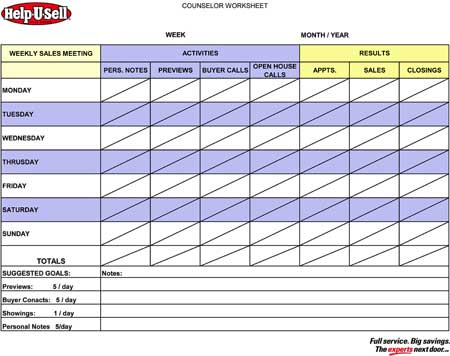
Expectations and minimum standards are a good start toward accountability, but there’s more to it than that.  Saying we expect a number of closed sides is great but you can’t manage ‘closed sides.’  You can’t make them happen.  They are an event, not an activity   You manage activities — the activities that lead to closed sides.  So part of your office culture should be an activity planning/commitment and accountability process.  Each buyer agent should commit to a certain number of activities every day and then report what they actually did.  This way, if they fall below the production expectation, we have something to go back to that might show us why.

Here’s a picture of the activity tracking sheet John Powell uses with each of his buyer agents.

And here’s a summary sheet he uses for an at-a-glance assessment of his entire sales team.

Step 7!

Both of these are available in the Download Library under ‘National Sales Meeting,’  ‘July 28, 2010’.  They are called ‘Tracking Sheets.’    You’ll note that each agent commits to a certain number of activities and then reports how many they actually did.

As broker/owner of a marketing oriented company, you also want to keep careful track of how each of your buyer agents are doing with leads.  In a perfect world, your admin answers every call and routes buyer leads to your team of buyer agents.  It’s the admin who logs the call and gives you a basis to go back to your agents and ask, ‘what happened to this one?’ and ‘did you do a Buyer Data Sheet on this one?’  The metrics you want to track are:  How many leads each agent received, how many resulted in a complete Buyer Data Sheet with contact information, how many Buyer Data Sheets resulted in appointments, and how many appointments resulted in sales.  This information becomes a management tool.  It will help you spot the one who needs more work on taking control of incoming calls and completing Buyer Data Sheets.  It will help you spot the one who can gather information but can’t seem to get an appointment.  It will also help you spot the one who works lots of leads but only closes a few.  It’s all about identifying areas for improvement and then working on them.

So, you get your entire office functioning in a culture of clear expectations, firm commitments and accountability . . . all’s right with the world, true?  Maybe.  But what about you?  Who’s holding you accountable?  Just like the best agent you’ve ever had, you at least need someone to run your ideas by, someone to remind you what you said you wanted to accomplish and get you back on track.  You could pay a coach — there are dozens out there and many swear by the results they get.  But I think you would be better served by staying in-house and getting involved in a structured coaching program at Help-U-Sell.  John, Ron McCoy, Jack Bailey and I are here and would welcome the opportunity to help you plot and scheme.  All it takes is a call . . .

And now, for Step 7!

Accessibility Toolbar