
How To Do It: Step 1 – Listing Market Share

(This is an elaboration of here ‘)

You’re starting out from scratch (or starting over from scratch . . . or barely scratching by and wanting to start over) and you want to take that first step:  build listing market share.  What do you do?  You don’t have much money and you may not see much on the horizon among your slim and tenuous pendings. Here’s the formula:

Learning:  The Elevator Speech and the Listing Consultation.  In today’s market you also want to check your knowledge of how to help a homeowner who is upside down or in distress.  Don’t worry about fancy schmancy objections and all the shiny things you can hang on these basic bits of information right now. There will time for that later.  You want to work the Elevator Speech until it flows off your tongue without any hesitation whenever anybody asks ‘What do you do?’  There are thoughts here and Step 2!as well as in the Operations Manual, posted in the Download Library.  You’ll also find the Listing Consultation in the DL Library along with video of John Powell working with a seller.  The whole consultation is important BUT there are two key pieces on which to focus:  The Service Comparison Chart and the Seller Savings Comparison.  They are the heart of the whole conversation.

Prospecting:  Start with people who are begging for your help:  FSBOs and Expireds.  Become obsessed with them and obsessive about contacting and maintaining contact with them.  Select powerful handouts to leave with them that differentiate you from the pack.  The old Help-U-Sell DVD, though a little dated, still works very well and, last time I checked was a bargain at about 40 cents apiece via NBS Printing, but a simple flyer that says who you are, and how you’re different is fine, too.

At the same time, mix in the folks who already know who you are and appreciate what you do:  past customers and clients.  Every day, call a few.  You’re catching up, giving them some market information (an item of value) and keeping your business in the top of their minds.

Marketing:  Choose your handouts for use with FSBOs, Expireds and anyone else you’ll be contacting.  You should have several so that you can go back to people with something new.  Also, doorhangers are important at this stage:  since you’re economizing you’ll want things you can leave on a door knob rather than mailing.  Doorhangers can be good for arounds and have the added benefit of giving you an opportunity to actually meet a neighbor face-to-face (if you deliver them yourself).  Speaking of arounds and brags — this is where to spend your marketing dollars in this first phase.  Your efforts are all about getting listings, so when you get one, pull out all the stops in exploiting the opportunities to market around it.

If you’re starting from scratch (or starting over from scratch), becoming visible is very important.  Make sure you present the benefits of seller involvement in the Listing Consultation.  Seller involvement frees you to do more high payoff activities and, if coached properly, means more directional and open house signs in the neighborhood that you don’t have to manage.  Supplement this growing number of signs with inexpensive Blitz Signs.  Even if you have to put them out on Friday and Pick them up Sunday evening, these little gems instantly make the statement that you are here and can save sellers thousands.  Consider investing in a car wrap.  You’ll spend $1,200 – $2,000 (I’m sure you could spend more) but you’ll have a mobile billboard you can park anywhere you want to make a statement.  If your budget is too tight at the moment, opt for magnetic car signs with the Help-U-Sell logo and use them! (drive nice).

Staffing:  If you’re starting from scratch you probably can’t afford help yet.  However, if you have the ability (rather, when you have the ability, which should be soon if you do what’s outlined here), the first person to hire is a good solid administrator who can take over most of the office activities and free you to be out meeting people.  Yes, a real estate license is a big plus and in today’s economy they are plentiful and available.

Time Management:  If the sun is up, the highest and best use of your time is meeting potential customers and at this point that usually means sellers.  Save learning (which is very important) for after 8 in the evening and before 8 in the morning.  When the sun is up become a people meeting machine.  Create opportunities to tell your story.  If you need some down time, schedule it for 2pm Eastern time on Tuesday and Wednesday.  Use that hour to attend the Help-U-Sell webinars to get fresh ideas and connect with other Help-U-Sell members.  Unless you have very thick skin, one of the things that will wear you down is the feeling of being all alone out there.  You’re not, and the Tuesday and Wednesday calls are an opportunity to tap in and re-energize.

Here is a Great Truth:  there’s no reason you can’t get 20 or more listings this month all by yourself.  Really.  A listing is something you can DO as Floyd Wickman used to say.  You can get out of bed this morning and say, ‘Today I’m going to get at least one new listing,’ and there are things you can DO to make that happen.  You can’t DO a sale — there are too many variables, too many other people involved.  But you really can go out and get a listing today and most every day if you make that your purpose.  I’m not much for fear motivation but really:  if someone held a gun to your head and commanded you to go out and get a listing, you could do it, right? So, if you are on the ‘Build Listing Market Share’ step, why not just decide you’re going to get one every day this month?   There will be days that something will block you, of course, but I bet if you are single-minded in the pursuit you can get 20 in 30 days.

OK?  On to Step 2!
How to Rule the (Real Estate) World in 10 Easy Steps

In chronological order:

  1. Go after Listing market share (Get more than your share of listings,  have more signs out than your competitors)
  2. Get Lisitng market share by offering a better deal than everyone else (it’s the low set fee, remember?)
  3. Use your growing Listing market share to build consumer awareness and interest.  (In other words maximize signage through seller involvement, exploit marketing opportunities for things like ‘arounds.’)
  4. Become expert on capturing buyer inquiries and faithfully track and follow-up with in-bound calls (there is no such thing as a ‘throw-away’ lead).
  5. Hire staff to help you take care of the large number of buyer leads your growing Listing market share is creating.
  6. Hold your staff (and yourself) accountable.  Not everyone is up to performing at the standard you set.  Your job is not to save them but to move them out and find someone who can do it.
  7. Start counting closed sides and comparing your results with the MLS:  your TRUE market share, the one based on closed sides, should be growing.
  8. Become the easiest company in town to work with.  That means know your stuff and play nice.  Just don’t stop being who you are.
  9. Study your bottom line (by the way:  it’s probably irrelevant until you get to this point).  What could you do to create more revenue and minimize expenses?  Where can you be more efficient?
  10. Look for ways to give back to your community.  It has enriched you, now find ways to make it better.

NOW:  Let’s take a closer look at Step 1!

Old Scripts/New Scripts

I love ‘scripts.’  I hate ‘scripts‘.  It’s a love/hate relationship.  Scripts are so phoney.  Yet, scripts can be the key that unlocks a great real estate career.  I know:  they unlocked mine.

Way back when dinosaurs roamed the earth (oh no, here he goes again), I was failing as a new real estate salesperson.  I was 25 and most of my buyers and sellers were 40 or better, so let’s just say I had a lot to overcome.  Completely frustrated after six months, I went to my local Board of REALTORS and checked out a set of Tom Hopkins’ cassette tapes.  Do we still listed to Tom Hopkins?  I don’t know. . . Anyway, Tom was very big on LEARNING THE SCRIPT WORD FOR WORD AND NEVER DEVIATING FROM THE SCRIPT!  As if the words had some magical power to make people say, ‘Yes!’

I’d drive around in my car, previewing property, listening to Tom Hopkins, saying to myself, ‘There’s no way I’m ever going to say any of this stuff, it’s not me,’ or ‘it sounds so fake.’  Still, I kept listening; and then the damndest thing happened.  I called on a FSBO (I had such a great attitude walking up to that door:  I knew I wasn’t going to get anywhere with this person because I’d never gotten anywhere with a FSBO before!).  She opened the door and stood there, arms folded across her chest and . . . suddenly Tom Hopkins’ words started coming out of my mouth.  I got the appointment and I got the listing.  Then I sold the listing in a couple of weeks sold the seller a house and listed two family members’ property.  It was the beginning of my success.

I became a devotee of scripts, a script junky.  I studied them all and I started to notice something:  while the early scripts were pretty much sales technique and tricks of tongue to get the other person to do what you wanted (‘I could stop by at 5, or would 7 be better?’ there is no bad answer to that question), the more sophisticated ones were just simple truths. I started noticing that when I learned a new script I was actually clarifying some basic piece of knowledge I already had and learning how to package it powerfully.  Let me give you an example:  my favorite script from 1987:

‘You know, Mr. FSBO, there really are only four kinds of buyers out there.’  (Intrigued, the FSBO raises an eyebrow or otherwise indicates he wants to know more).

‘There’s the first time buyer.  I love  them;  they are so rewarding to work with.  But you know what?  They’re usually scared to death.  I often have to sell them three or four times on completing the purchase they’ve already made.  Plus, they rarely buy directly from an owner.  They need help and they know it.  It’s probably not a buyer you’re going to find as a FSBO.’  (Is that true?  Yes!)

‘Then there’s the move-up buyer.  This is the local person who’s wanting to go to a newer, better, or bigger house.  They’re great buyers too and you know what?  You CAN find them.  They do shop FSBOs because the number one thing on their list of wants is:  it has to be a bargain and they think that’s what FSBO means.  Plus, when they decide they want to buy your house, you know what they have to do before they close?  Right:  sell their house.  Hardly your best buyer.’  (True?  Pretty much).

Third is the Investor or Speculator.  It’s really two buyers but I lump them together.  The Investor wants to steal the property so he can have a positive cash flow when he rents it.  The Speculator wants to steal the property so he can do some cosmetics and then flip it for a profit.  The operative phrase, of course, is ‘Steal the property.’  You can find them all day long, but you probably don’t want to deal with them.’  (True?  I think so — all that ‘steal the property‘ stuff is just packaging the truth that they’re going to want a good deal.)

‘Finally there’s the quality buyer from out-of-town, the transferee.  Now, think about it.  Suppose you were moving to, say, St. Louis, and you’d never been there in your life and really didn’t know anyone there.  Your company is giving you a long weekend to come into town and find a place to live.  Are you going to trust yourself to find the right house at the right price in the right neighborhood?  I sure wouldn’t.  And transferees rarely do. They seek the professional help of a REALTOR who can keep them from making a big mistake.  The transferee is a buyer who rarely looks at FSBOs because they don’t have time and they don’t know enough on their own.  It’s a buyer that’s largely unavailable to you.  And it’s the buyer I can bring.’  (True?  Mostly.)

All of that was stuff I already knew back in 1987 on some level.  The ‘script’ was just a way of clarifying it and packaging it.

Today I think scripting is mostly about first knowing your business, then about finding ways to present what you know powerfully.  I think it’s fine to learn a Mike Ferry or Brian Buffini or David Knox script, but while you learn it, tie it to your base of knowledge.  Make it your own.

Today’s scripts are different.  In the old world it was all about ‘how can I get this person to buy or sell.’  Today it’s all about solving problems.  Seems everybody’s got some kind of real estate problem and our scripting needs to be focused on this.  For example, I got a glimpse of one that went something like, ‘You’re like so many other homeowners today who find themselves upside down and possibly  unable to keep up mortgage payments.   What you need to know is that you have options.  In fact, I have nine strategies that can help.  When can we get together to review them?’  I don’t know what the nine strategies are but I’ll bet one of you does.  How about sharing it here in a comment (or via email to me if you’re worried about your competitors stealing your silver bullets).  What are your favorite scripts today?  What seems to carry the most weight when you speak to a buyer or seller?  I’d really like to know.

Smack A Young Person Today! (It’s All Their Fault)

Here’s a little statistical analysis for you, courtesy of NAR.  First is a chart comparing rates of homeownership by age group in 2004 with the second quarter of 2010:

The blue line is the 2004 rate, the green is 2010 and the yellow is the % difference in the two.  What’s important is that homeownership has declined for every age group since 2004 with the biggest decline occurring in the under 35 group.  The good news:  there’s a whole lotta folks out there who NEED to buy a home!

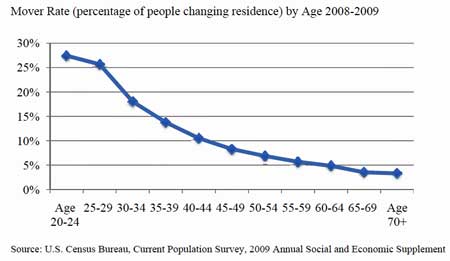
Here’s another graph, this time from the Census Bureau.  It’s showing the ‘Mover Rate’ — which tells us who’s moving around out there.  Again, it’s the under 35 set that’s moving the most.  They are running around like chickens with their head cut off when what they should be doing is so simple:  buy a home!

Finally, here’s a non-comparative graph showing rates of homeownership, again by age:

Again, it’s that under 35 set that has the greatest need.

So, it’s younger people who are moving around the most, who have the greatest NEED to buy, but who are pulling back from homeownership at a faster rate than anyone else!  And all of this is happening at a time when interest rates are very low and housing is more affordable than it’s been in decades.

I sniff a sales challenge here.  What are we saying to the under 35 set to get them interested in buying real estate?  What should we be saying?  Does the old rent vs. buy analysis still work?  Or is it old hat?  What’s it going to take to get these folks off the fence and back into the market?

I also believe it’s time for young people to step up and take responsibility for this mess!  Clean it up!  Young people:  it is your DUTY to get out and buy a home this week.  You don’t just owe it to yourself, you owe it to your ECONOMY!  Personally, I think each of us should go out and find someone under 35 and just smack them!  It’s all their fault!

Financing Home Mortgage and Repairs At Once

The  FHA 203(k) mortgage program is the bomb (that’s for the gen Y’rs out there . . . for us Flower Children, it’s way cool).  With this program, a home buyer can choose a property in need of repair and finance the cost of fixing it up right in with the mortgage.  The repair and renovation money is held in escrow after closing and is doled out as repairs are made.  This is beneficial to the home buyer as repairs are financed under the same terms as the home mortgage (usually that means lower interest, longer term and, therefore, lower payment).  It also makes the home in need of serious repair — often the best buy in the market — an option for the average home buyer.

But here’s the catch:  in order for this great program to work, everyone has to know their stuff!  Most mortgage people have never done a 203(k).  Most agents haven’t a clue about how to go about putting together a deal involving this kind of financing.  Home buyers and agents are stymied when they contemplate how they are going to coordinate all of the bids and contractors involved in a project like this.  Suddenly it looks  like a 203(k) purchase is out of the question for most.

If you’re interested, however, there are some great resources out there.  My San Diego area B of A Mortgage Loan Originator, Rob Webber,told me he has access to a specialized team of Mortgage Reps who do nothing but 203(k) loans.  That’s a good start.  And today I read about REbuildUSA, a network of agents and lenders who have trained and become certified in working this kind of transaction.  REbuildUSA has just designated Lowes as their remodelling partner.  Now, working with a REbuildUSA certified agent, a purchaser can go into Lowes and get their entire project bid, from materials to contractors and schedules.  It’s one stop and all the gritty work is done.

I think this is an outstanding development.  We’ d all like to work these kinds of transactions (and they will become more prevalent as time goes on) but few of us have the time or resources to figure it out on our own.  REbuildUSA has created a path on which to run and has simplified the process of getting home buyers into rehab property.  To learn more about their program, click HERE.

Accessibility Toolbar