
Syndication Storm

First, let’s understand what syndication is.  When a real estate broker submits a listing to the MLS, he/she is given the choice whether to share the listing with various Internet property portals:  Trulia, Zillow, Realtor.com and many more.  At Help-U-Sell, with the broker’s agreement, we pull all property listings from the MLS via an IDX feed – that’s how we get the Help-U-Sell broker’s listings (along with all the others in the MLS) into helpusell.com.  We also share information with dozens of Internet portals and our brokers can opt in or out of that sharing for their individual listings.  That’s syndication.

These portals – let’s call them what they are:  aggregators – present the listing data on their own sites and use the traffic they generate to sell advertisements.  The advertisers are usually REALTORS who want to be seen as the knowledgable expert in their areas.

I remember Dale Strack railing on about this seven years ago.  ‘First they get you to share your data with them – For Free! – then they turn around and sell the leads your data generates back to you!’ he’d say.  And he was right:  we real estate pros often take the easiest path . . .  I mean:  we could have done the work the aggregators did to get our listings seen and preserve the leads not for advertisers but for the source of the data, but we didn’t.  We had a long and rich history of hoarding information from consumers and the thought of opening up our own treasure trove of data was repugnant to us!  We opted to let someone else do that.

Thank goodness we did.  Now the consumer has almost all the information we used to hoard from them!

But now there is this tempest brewing.  It started a few months ago in Minnesota, where the gigantic Independent firm, Edina, opted out of syndication on their listings.  A few firms followed over the following months and then, last week, Jim Abbott from San Diego pulled his firm out.  Abbott is not near the heavy weight that Edina is, but he understands media and created a very compelling video about his decision.  The video has gone viral in the real estate community and I’m sure will bring this issue to the forefront for many.  Here – give it a look:

Abbott’s frustration is that his listings are generating leads for other brokers.  And he is correct, it is almost impossible to find listing agent information on most of the portals.  The only agents easy to find are those who ponied up the cash for premium accounts – and there is no screening process for agents wanting to advertise in this way.  The consumer is as likely to find a Dud this way as a Star.

Imagine the frustration of a great agent who takes dozens of good property listings and sends them out to the syndicators.  Meanwhile a new agent or a failing one inks an agreement with a syndicator to become a ‘Preferred Agent’  and snares a quality lead on one of those listings.  Because they know nothing about the property (and little about the business), they lean heavily on the listing agent through the showing, offer and acceptance process.  The listing agent feels as if he/she carried the selling agent through the sale and is bothered by the low level of service the buyer client received from their agent.

I think pulling the plug on syndication is a noble thing.  I’m not sure it’s practical.  Truth is, I hear from my brokers every week that the preferred agent programs on Trulia and especially on Zillow work:  they produce leads. And today, it’s a rare broker who pulls the plug on anything producing leads.

Funny:  there’s been an alternative – actually a better program than that of any of the aggregators – out there for years:  ListingBook.  It’s free to agents and brokers, gives consumers real time access to the local MLS and the same listings the aggregators have, and preserves the lead for the agent who brings the prospect into ListingBook.  It’s the consumer centric alternative to the problems Abbott is talking about in his video.  I’ve been pushing ListingBook for years: it’s a wonderful way to give the very best infomation to your clients without giving up control.  If brokers understood its power there would be no need to syndicate to anybody.

I am very curious about where you weigh in on this and would welcome your comments.  We’re also going to spend a little time on the issue on our Wednesday Help-U-Sell Power Hour.  So please plan to attend.
Core Values

Up until about 2006 we had a very coherent statement of those things we hold most dear:  our Core Values.  Great care was taken in the creation of the list.  We didn’t want what usually passes for this kind of statement – a bland list of noble words that don’t really describe the company.  We wanted this list to be real.  And it was.  But then there was a changing of the guard in 2006 and the old set was scrapped and replace by somebody else’s idea of who they wanted to be . . . and the original list was abandoned.

I’ve been thinking about that original list lately and I’d like to revive it.  It truly describes who we are (not who we want to be, but who we really are right now).

1.  Integrity

  • We tell the truth.
  • We believe so deeply in our product that we don’t have to stoop to techniques and manipulation to be successful:  all we have to do is tell people what we have.
  • We provide a valuable service for a reasonable fee.
  • We make an honest living.  We don’t  ‘make a killing’ on every closing. We are paid fairly by the people we serve.
  • We believe in our program.
  • We realize we are different.  We have a unique offering for the consumer that is fundamentally better than what traditional brokers offer.
  • Our system works.  Period.
  • Our words, our actions and our beliefs are in sync.  We don’t say one thing but do something else.

2.  Information without obligation

  • We don’t hoard or hide information.
  • We answer questions honestly without technique or manipulation.
  • Our selling style is to educate; we empower our customers with information.

3. Consumer choices

  • One size does not fit all.
  • We allow the consumer to choose the services he or she would like to employ and then we charge them based on how the home actually sells.
  • Our focus is always on how we can better serve the consumer.

4. Seller participation

  • We believe in our customers’ ability to handle some aspects of the sale.
  • We partner with our sellers to market their property.  We HELP YOU sell your property.
  • We coach our sellers through the process.

5. Seller savings

  • Because we always have our customers’ best interest at heart, the more we can save them, the better.
  • We deliver high value service for a set fee considerably lower than the commissions charged by other offices.

6. Buyer/Seller contact

  • Because we believe in our service, we don’t have to justify our existence by getting between the parties.
  • We believe that most people are honest and principled.
  • Our job is to coach, educate and facilitate a successful transaction.

7. Unique management model

  • We believe that we can offer a high value service to consumers and make a healthy profit at the same time.
  • We organize our offices to serve the consumer, not the agent.
  • We believe it is our business; we hire people to help us do more of it and do it better.

8. Powerful marketing system

  • We are a marketing company.  We study our marketplace and our marketing to make sure we are maximizing results.
  • We have a marketing plan and we stick to it.
  • We measure results.
  • We actively market real estate

And here it is once again without the extra verbiage:

  • Integrity
  • Information without Obligation
  • Consumer Choices
  • Seller Participation
  • Seller Savings
  • Buyer/Seller Contact
  • Unique Management Model
  • Powerful Marketing System

This set of 8 Core Values is more than mere words on a page.  It is a living breathing entity, one we use every day to remind us who we are and to help in decision making.  Any time you are considering a change to your program or a new piece of marketing or a new way of doing anything, take out the list and weigh what you’re considering against it.  If it does not align with your 8 Core Values, then it’s probably something you shouldn’t do.  We are a principal centered organization and these are the principals on which we base our business.  Be proud of them. Display them.  Share them with your staff and give them a little time every day.


Big Brother, Google and Print Media

Has it occurred to you yet that Google – at least the search engine part of Google – is, essentially, a monopoly?  They have achieved such penetration in the realm of Internet search that, what few competitors there are,  are insignificant.

I remember when I started surfing the net back in the 90’s.  None of us knew what we were doing and AOL gained a huge leg-up by organizing the Internet (today that seems so silly) and by giving us crude search capabilities.  I drifted from search engine to search engine and eventually settled into AltaVista.  In the mid-nineties AltaVista leaped ahead of its competitors by pioneering the use of web-crawlers that would go out, scan websites for information, and return data for indexing.  Today we call the crawlers ‘Spiders’ and they scamper a little faster.  AltaVista was eventually bought by Yahoo and, in May of last year, was shut down.  Now, when you try to search using AltaVista, you’re really searching using Yahoo.  As an interesting aside, it was AltaVista that brought us that wonderful translation tool, Babel-Fish.  Just as the search part of AV has been over taken by Google, so has Babel-Fish:  today we use Google Translate.

Which brings me back to the Google monopoly.  They didn’t gain that position by destroying or overtaking competitors; we gave it to them.  Google came out of the box so far ahead of their competitors that almost overnight other search engines were left in the dust.  Google made the Internet useful.  It brought order to chaos.  That’s the nice part.  But to monetize search, Google had to bring value to those of us with something to sell or something to say.  They realized (just as Don Taylor did in 1976) that the most effective marketing was highly targeted marketing.  The delivery of a highly targeted demographic to an advertiser proved to be very valuable and targeted pay-per-click ads became a dominant feature of the Internet.

So, how did Google get so good at segmenting and categorizing demographic groups to deliver to advertisers?  They kept track of us.  They recorded what we searched for and what we clicked on.  They watched how we behaved when we interacted with them and they stored that information, analyzed it, reduced it to numbers and predictive algorithms.  Today Google knows more about what interests me than just about anyone else!

We’d like to believe that Google is blind, like justice.  We’d like to believe that if I – a White male in his 60s living in Southern California – search for something, that you – a Hispanic female in your 30s living in the Northeast – also search for, we’d get the same results.  Not so. Google not only sells you as a potential target to advertisers, it also uses what it knows about your online behavior to filter search results so that your search outcome may be very different than mine.

I got a big reminder of this yesterday.  Ron McCoy, who lives 90 miles away in Riverside, just bough an IPad II.  The Apple version of PowerPoint on the IPad is something called Notebook.  Ron wanted to convert his PowerPoint Franchise Sales Presentation to Notebook and had no luck figuring it out.  While we were on the phone, I Googled it and quickly came up with a website devoted to Notebook with a long string of how-to’s about this very subject.  When Ron did the same search the website was buried. Google gave us different results because:  we live in different areas and we search for different stuff.  Google watches . . . Google knows.

Don’t get me wrong.  I love Google.  I’m more a Google person than a PC (Microsoft) person.  I have a Google T-Shirt.  I have an Android phone.  But sometimes all of this Google-looking-over-my-shoulder-while-I-browse creeps me out a bit.  Sure, their motives are purely Capitalistic:  they want great data on me to sell to advertisers.  But what if their information came under the control of an entity – a faction, a government, a policing unit – who maybe had other motives?  Makes me want to browse through an anonymizer!

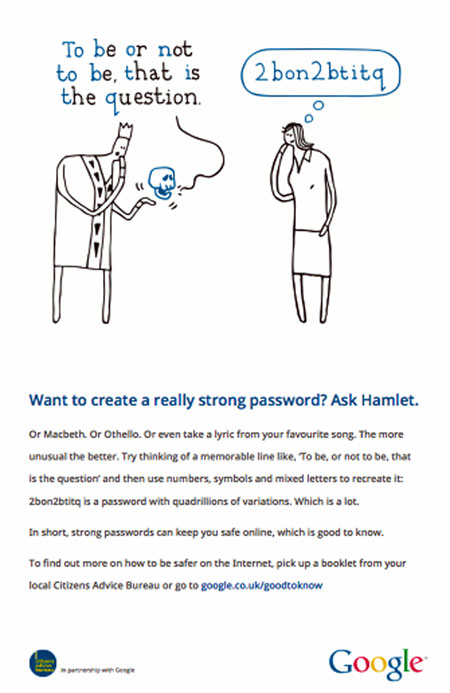
I applaud Google for what its done to marketing.  That arena is fundamentally different and the difference is directly related to what Google did.  But it’s interesting:  after years of diss-ing print media as the nearly extinct dinosaur that it is, Google has taken to using traditional paper advertising to show its concern for our online safety.  They’ve earmarked tens of millions of dollars for a ‘Good to Know’ campaign running in newspapers and magazines.  The first ad ran in Britain recently and encouraged people to be a little more creative with their passwords.  It’s actually very good information, so good that I’ll reproduce the ad here and encourage you to do what Mother-Google is asking you to do!


Having gotten all of that rambling tangential junk out of the way, here’s my point for you today:  If Google – who owns the Internet – who invented online marketing – is getting into print advertising, isn’t’ it something you ought to consider for your business?   For five years we’ve preached that print is dead-dead-dead, and every time one of our brokers put a toe in the print-media waters he pulled it back in shock and horror.  But suddenly, Maurine Grisso takes a full page ad in her local paper for a song the week between Christmas and New Years and actually develops LEADS.  I know:  Maurine is a brash pioneer, sometimes so far on the cutting edge that she’s actually on the bleeding edge; but nobody can fault her for not taking risks and sometimes reaping big rewards.  And I’m not suggesting you sink thousands of dollars into print advertising this month or next.  What I am suggesting is that it might be time to put that toe back in the water.  Spend $50 or $100 and run a little ‘Sell Fast – Save Thousands’ ad or something similar.  Try putting a true ETM (with sold-and-saves, testimonials, and an Easy Way plus a few listings) on the back of a Homes magazine.  Pay very close attention to the results you get:  how many inquiries does this specific ad produce?  Then let me know if Google and Maurine are right or if it’s still too early.  Thanks!

YAWN . . .

Quoting Inman News this morning:

NEW YORK — Realtor.com is about to roll out a free tool that will allow real estate professionals to build single-property websites optimized for mobile devices.

We’ve had that for what?  A year?  18 months?

Oh, and with our version, the agent doesn’t have to ‘do’ anything . . . it all happens automatically on every listing.  Period.

Richard Cricchio, Help-U-Sell and the Office Exclusive Listing

We had quite a Roundtable Call today.  Lots of good information flew around, but one item really struck me.

Richard Cricchio from Honolulu started talking about ‘Office Exclusive Listings.’  I asked him to clarify and he responded:

‘When we take a call on a listing, we always ask if the caller is working with an agent.  If they’re not, we send them directly to the seller to arrange a showing.  The seller shows the house and we followup afterward.  That way, if the buyer moves forward on the house, all the seller pays is the Set Fee.  They save the largest amount of money.  We’ve always done that on all of our listings and it’s helped drive the message that we are about savings.’

It sounded like such a radical idea.

But it’s not.

It’s about 35 years old.  It’s a thing called ‘Help-U-Sell’.  That’s how this company was designed by Don Taylor.  That’s why it’s called ‘Help-U-Sell‘.  As we turned the corner on the new millennium, we started adjusting the model here and there.

First, the seller’s phone number came off the for sale sign.  Remember, for 25 years, our listings were ‘For Sale WITH Owner’ and we put the sellers number on the sign so buyers could contact them directly.  We did that for two reasons:  first, it gave the seller the greatest opportunity to save, which is what we wanted so they’d tell everyone they know about us and second because it’s a way of multiplying our efforts, enabling us to more that we’d otherwise be able to do.

Then we started capturing buyers and showing our listings ourselves.  Sellers still could find their own buyers by holding open houses and talking the house up with the neighbors and at work.  But we wanted a relationship with that buyer, so we started handling the showings ourselves.

I’m not saying either of these adjustments was wrong.  But I do think it’s interesting that the guy who is way out ahead of the pack in our currently running Winter Warm Up Contest is still sending buyers directly to his sellers.  How much time are you spending each week running over to show a listing to a new buyer?  If your sellers handled that task for you, what else could you be doing with that time?  Are your followup skills strong enough that you could still build a relationship with that buyer after they’ve seen the listing with the seller?  After all, most of the time they’re not going to buy that house anyway.

In today’s market, where so many sellers have so little equity, I’d think giving them the greatest change of finding their own buyer and saving the largest amount of money would be very appealing.  Think about it.

Accessibility Toolbar